Browsing by Subject "Apartheid"
Now showing items 1-20 of 49
-
The absurdity of reconciliation. What we (should) learn from Rustenburg and the implications for South Africa
(Pieter de Waal Neethling Trust, 2020)The quest for reconciliation in South Africa is an exercise in the absurd. To say it is an exercise for the absurd might also have some merit. Like Sisyphus, the figure in Greek mythology, those engaged in the quest for ... -
Africa after apartheid: South Africa, race, and nation in Tanzania
(Routledge, 2016)South African economic and political expansion into the African continent has been a controversial feature of the post-apartheid era. Now human geographer Richard Schroeder has taken up the matter in an ethnographic study ... -
Anxious urbanity: xenophobia, the native subject and the refugee camp
(Routledge Taylor Francis Group, 2013)Could we think of the black subject under apartheid as a refugee, and might this condition be the paradigmatic metaphor for thinking about the postcolonial African predicament of citizenship? This paper considers the ... -
Apartheid and the unconscious: An introduction
(Taylor and Francis Group, 2023)This special issue invited contributors to revisit J.M. Coetzee’s “The Mind of Apartheid,” first published in Social Dynamics in 1991. Here, Coetzee asks what it might mean to come to terms with apartheid:It is not ... -
Apartheid space and fractured power: Vicious cycles of poverty in Cornfields, KwaZulu-Natal
(Institute for Poverty Land and Agrarian Studies (PLAAS), 2010)Apartheid space and fractured power: vicious cycles of poverty in Cornfields, KwaZulu-Natal A neglected area in the literature on structural poverty is changing land tenure relations and the disconnect with planning ... -
Apartheid's university: Notes on the renewal of the Enlightenment
(CODESRIA, 2007)This paper sets to work on strategies for forging new and critical humanities at the institutional site of the university that appears to be trapped in the legacies of apartheid. The paper suggests that the university's ... -
Auditing and the unconscious: Managerialism’s memory traces
(Taylor and Francis Group, 2023)This paper takes J.M. Coetzee’s “The Mind of Apartheid” as a point of departure in thinking about audits in universities. Using the psychoanalytic framing of apartheid that Coetzee puts in place, audit is likened here ... -
Between racial madness and neoliberal reason: Metonymic contagion in apartheid biopower
(Taylor and Francis Group, 2023)I will seek to consider the simultaneous workings of race and capital in apartheid biopower. J.M. Coetzee offers a reading of apartheid racism as racial madness which is imbricated with economic reason. In the wake of the ... -
Beyond nostalgia in the search for identity: Black liberation theology and the politics of reconciliation
(AOSIS, 2021)Practitioners of Black liberation theology often reflect on the emergence of this theological expression by means of a nostalgic launch into the past, seeking ways to address some of today’s most pressing concerns. In ... -
Black health, ethics, and global ecology
(Taylor and Francis Group, 2022)The reflections offered here come from someone the South African government classified as white or as European under apartheid, who continues to be classified in that manner under affirmative action, and who has worked at ... -
Bureaucratically missing: Capital punishment, exhumations, and the afterlives of state documents and photographs
(University of the Western Cape, 2018)For their families, the bodies of many of those hanged by the apartheid state remain missing and missed. Judicial executions, and the corpses they produced, were hidden from the scrutiny of the public and the press. While ... -
The Centre for Multilingualism and Diversities Research at the University of the Western Cape, South Africa
(University of the Western Cape, 2014)There is an urgency in theorising how diversity is negotiated, communicated, and disputed as a matter of everyday ordinariness that is compounded by the clear linkages between diversity, transformation, voice, agency, ... -
City of Cape Town libraries' segregated history: 1952-1972
(University of KwaZulu-Natal, 2015)This article investigates the history and development of the Cape Town City Libraries (CTCL) from 1952-1972 and examines the effect of apartheid legislation on establishing a public library system. Legislation introduced ... -
Community and marine conservation in South Africa: Are we still missing the mark?
(Frontiers Media, 2022)Marine Protected Areas (MPAs) in South Africa have a long history with currently 5% of the mainland’s ocean territory protected. The MPAs are celebrated and appreciated for their representative coverage of several habitat ... -
Confronting apartheid. A personal history of South Africa, Namibia and Palestine, John Dugard
(Juta, 2021)John Dugard is a household name in the law of South Africa. Perhaps even before that, but certainly since his inaugural lecture was published fully 50 years ago (see 'The judicial process, positivism and civil liberty' ... -
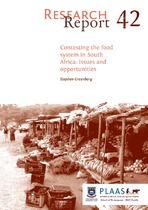
Contesting the food system in South Africa: issues and opportunities
(Institute for Poverty, Land and Agrarian Studies, University of the Western Cape, 2010)This report widens the debate about food production and distribution in South Africa to consider some of the entrenched power dynamics that shape the way these happen, and to consider whether a more radical transformation ... -
Crime, community and the governance of violence in post-apartheid South Africa
(Taylor and Francis Group, 2008)The South African government has embarked on a programme ofencouraging social cohesion in South Africa first to address concerns stemmingfrom high levels of violent crime which characterise the society, and second, ... -
A critical appraisal of South Africa’s market-based land reform policy: The case of the Land Redistribution for Agricultural Development (LRAD) programme in Limpopo
(Institute for Poverty, Land and Agrarian Studies, University of the Western Cape, 2004)In 1996 less than 1% of the population owned and controlled over 80% of farm land. This 1% was part of the 10.9% of the population classified as white (Stats SA 2000). Meanwhile, the 76.7% of the population that is ... -
Eleventh annual Julius Nyerere memorial lecture in 2014
(University of the Western Cape, 2015)The event included a live performance by Jana Natya Manch (The People’s Theatre Group), also known as Janam (Birth). Janam has created original plays for the past 40 years; they have performed more than 8000 times in over ... -
Factors influencing the career choice of undergraduate students at a historically disadvantaged South African university
(IP Publishing, 2015)During the apartheid years in South Africa, career guidance amongst disadvantaged learners was largely absent and, for many, career choices were limited and governed by politics. Despite South Africa having celebrated ...