Browsing by Author "Whande, Webster"
Now showing items 1-6 of 6
-
Challenges and prospects for trans-boundary fisheries in Lakes Chiuta and Kariba
(Institute for Poverty, Land and Agrarian Studies, University of the Western Cape, 2006)Community-based conservation (CBC) is a prominent feature of conservation and development policy and practice in southern Africa. It is a generic concept defining different configurations of controlling access to and use ... -
Community-based natural resource management in the southern Africa region: An annotated bibliography and general overview of literature, 1996–2004
(Institute for Poverty, Land and Agrarian Studies, University of the Western Cape, 2007)This bibliography is aimed at collating information relating to community-based natural resource management (CBNRM) in the southern African region across different sectors and themes. It was primarily compiled to offer ... -
Community-based natural resource management in the Southern Africa region: an annotated bibliography and general overview of literature, 1996–2004
(PLAAS, University of the Western Cape, 2007-02)This bibliography is aimed at collating information relating to community-based natural resource management (CBNRM) in the Southern African region across different sectors and themes. It was primarily compiled to offer ... -
Local communities, equity and conservation in southern Africa: A synthesis of lessons learnt and recommendations from a southern African technical workshop
(Institute for Poverty Land and Agrarian Studies (PLAAS), 2003)This publication reports on a technical workshop entitled ëCommunities and Conservation in Southern Africa: Key Issues and Challenges towards a more Equitable and Sustainable Futureí, which was held on 26ñ28 February 2003 ... -
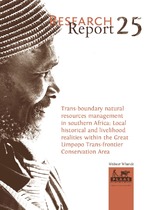
Trans-boundary natural resources management in southern Africa: Local historical and livelihood realities within the Great Limpopo Trans-frontier Conservation Area
(Institute for Poverty, Land and Agrarian Studies, University of the Western Cape, 2007)The end of apartheid rule in South Africa, together with the termination of the civil war in Mozambique and the occupation of Namibia by South Africa in the early 1990s, seemed to herald profound changes in international ... -
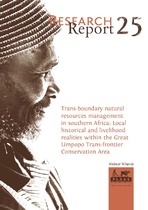
Trans-boundary natural resources management in Southern Africa: Local historical and livelihood realities within the Great Limpopo Trans-frontier Conservation Area
(PLAAS, University of the Western Cape, 2007-08)The end of apartheid rule in South Africa, together with the termination of the civil war in Mozambique and the occupation of Namibia by South Africa in the early 1990s, seemed to herald profound changes in international ...