Browsing Institute for Microbial Biotechnology & Metagenomics by Subject "Antarctica"
Now showing items 1-6 of 6
-
Cowan, Donald A.; Mamais, A.; Russell, Nick A.; Sheppard, Devon M. (Springer Verlag, 2002)[more][less]
Abstract: We have applied bioluminescent ATP detection methods to microbial enumeration in Antarctic Dry Valley mineral soils, and validated our ATP data by two independent methods. We have demonstrated that ATP measurement is a valid means of determining microbial biomass in such sites, and that the desiccated surface mineral soils of the Antarctic Dry Valleys contain cell numbers over four orders of magnitude higher than previously suggested URI: http://hdl.handle.net/10566/162 Files in this item: 1
CowanAntacticDryValleys2002.pdf (475.3Kb) -
Ah Tow, Lemese; Cowan, Donald A. (Springer Verlag, 2005)[more][less]
Abstract: Continental Antarctic is perceived as a largely pristine environment, although certain localized regions (e.g., parts of the Ross Dependency Dry Valleys) are relatively heavy impacted by human activities. The procedures imposed on Antarctic field parties for the handling and disposal of both solid and liquid wastes are designed to minimise eutrofication and contamination (particularly by human enteric bacteria). However, little consideration has been given to the significance, if any, of less obvious forms of microbial contamination resulting from periodic human activities in Antarctica. The predominant commensal microorganism on human skin, Staphylococcus epidermidis, could be detected by PCR, in Dry Valley mineral soils collected from heavily impacted areas, but could not be detected in Dry Valley mineral soils collected from low impact and pristine areas. Cell viability of this non-enteric human commensal is rapidly lost in Dry Valley mineral soil. However, S. epidermidis can persist for long periods in Dry Valley mineral soil as non-viable cells and/or naked DNA. URI: http://hdl.handle.net/10566/146 Files in this item: 1
AhTowDissemination2005.pdf (393.6Kb) -
Cowan, Donald A.; Ah Tow, Lemese (Annual Reviews, 2004)[more][less]
Abstract: The Antarctic continent harbors a range of specialized and sometimes highly localized microbial biotopes. These include biotopes associated with desiccated mineral soils, rich ornithogenic soils, glacial and sea ice, ice-covered lakes, translucent rocks, and geothermally heated soils. All are characterized by the imposition of one or more environmental extremes (including low temperature, wide temperature fluctuations, desiccation, hypersalinity, high periodic radiation fluxes, and low nutrient status). As our understanding of the true microbial diversity in these biotopes expands from the application of molecular phylogenetic methods, we come closer to the point where we can make an accurate assessment of the impacts of environmental change, human intervention, and other natural and unnatural impositions. At present, it is possible to make reasonable predictions about the physical effects of local climate change, but only general predictions on possible changes in microbial community structure. The consequences of some direct human impacts, such as physical disruption of microbial soil communities, are obvious if not yet quantitated. Others, such as the dissemination of nonindigenous microorganisms into indigenous microbial communities, are not yet understood. URI: http://hdl.handle.net/10566/145 Files in this item: 1
Endangered Antarctic Environments.docx (12.30Kb) -
Sjoling, Sara; Cowan, Donald A. (Springer Verlag, 2003)[more][less]
Abstract: The microbial diversity in maritime meltwater pond sediments from Bratina Island, Ross Sea, Antarctica was investigated by 16S rDNA-dependent molecular phylogeny. Investigations of the vertical distribution, phylogenetic composition, and spatial variability of Bacteria and Archaea in the sediment were carried out. Results revealed the presence of a highly diverse bacterial population and a significantly depthrelated composition. Assessment of 173 partial 16S rDNA clones analyzed by amplified rDNA restriction analysis (ARDRA) using tetrameric restriction enzymes (HinP1I 5'GVCGC3'and Msp I. 5'CVGG3', BioLabs) revealed 153 different bacterial OTUs (operational taxonomic units). However, only seven archaeal OTUs were detected, indicating low archaeal diversity. Based on ARDRA results, 30 bacterial clones were selected for sequencing and the sequenced clones fell into seven major lineages of the domain Bacteria; the a, c, and d subdivisions of Proteobacteria, the Cytophaga–Flavobacterium– Bacteroides, the Spirochaetaceae, and the Actinobacteria. All of the archaeal clones sequenced belonged to the group Crenarchaeota and phylogenetic analysis revealed close relationships with members of the deep-branching Group 1 Marine Archaea. URI: http://hdl.handle.net/10566/148 Files in this item: 1
Sjoling16SrDNA.pdf (543.4Kb) -
Ah Tow, Lemese; Cowan, Donald A. (Society for General Microbiology, 2003)[more][less]
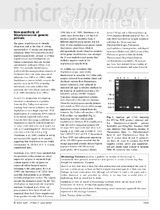
Abstract: Our results allow us to conclude that there appears to be significant conservation between the tuf genes of Planococcus, Planomicrobium and Staphylococcus spp., and that although the primer set TstaG422/TStag765 has been shown to possess high specificity, its use for the definitive identification of Staphylococcus spp. must be treated with some caution. Description: Published as a "Microbiology Comment": this provides a platform for readers of Microbiology to communicate their personal observations and opinions in a more informal way than through the submission of papers. URI: http://hdl.handle.net/10566/143 Files in this item: 1
AhTow&Cowan2003.PDF (251.5Kb) -
Baker, Gillian; Ah Tow, Lemese; Cowan, Donald A. (Elsevier, 2003)[more][less]
Abstract: PCR-based technologies are widely employed for the detection of specific microorganisms, and may be applied to the identification of non-indigenous microorganisms in ‘pristine’ environments. For ‘pristine’ environments such as those found on the Antarctic continent, the application of these methods to the assessment of environmental contamination from human activities must be treated with caution. Issues such as the possibility of non-human dispersal of organisms, stability and survival of non-indigenous organisms in vivo, the sensitivity, reproducibility and specificity of the PCR process (and particularly primer design) and the sampling regime employed must all be considered in detail. We conclude that despite these limitations, PCR and related technologies offer enormous scope for assessment of both natural and non-indigenous microbial distributions. URI: http://hdl.handle.net/10566/149 Files in this item: 1
BakerPCRdetection2003.pdf (391.8Kb)
Now showing items 1-6 of 6