Browsing Institute for Poverty, Land and Agrarian Studies (PLAAS) by Issue Date
Now showing items 21-40 of 608
-
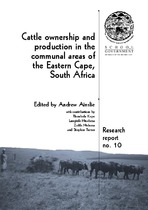
Cattle ownership and production in the communal areas of the Eastern Cape, South Africa
(Institute for Poverty, Land and Agrarian Studies, University of the Western Cape, 2002)This report documents a study of the social and economic structure of cattle ownership and production in the communal tenure areas of the Eastern Cape (i.e. the former Bantustans of Transkei and Ciskei). The report ... -
Radical land reform is key to sustainable rural development in South Africa
(Institute for Poverty, Land and Agrarian Studies, University of the Western Cape, 2002)Sustainable rural development in 21st century South Africa will never be achieved without a radical assault on the structural underpinnings of poverty and inequality inherited from three centuries of oppression and ... -
A decade of fisheries co-management in Africa: Going back to the roots? Empowering fishing communities? Or just an illusion?
(Institute for Poverty Land and Agrarian Studies (PLAAS), 2002)This paper provides an overview of co-management in Africa and the historical, political and paradigmatic reasons for the shift. The historical context is important when analysing the performance of the regime. The main ... -
Annual report 2001
(Institute for Poverty Land and Agrarian Studies (PLAAS), 2002)PLAAS continues to grow and to take on new projects and staff. This presents a number of challenges, not least of which is the sustainability of such growth. The year 2001 saw the completion of a twelve month-long ... -
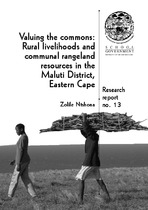
Valuing the commons: Rural livelihoods and communal rangeland resources in the Maluti District, Eastern Cape
(Institute for Poverty, Land and Agrarian Studies, University of the Western Cape, 2002)The ‘hidden’ value of wild resources, trees and grazing resources on communal rangelands is often overlooked by conventional economic assessments, even though their contribution to people’s lives is enormous. There is ... -
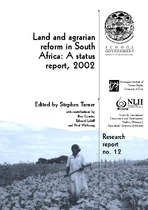
Land and agrarian reform in South Africa: A status report, 2002
(Institute for Poverty, Land and Agrarian Studies, University of the Western Cape, 2002)In 1994, South Africa started a new life as a democratic nation. It faced immense challenges. Multiple economic, social and political transformations were needed to overcome the legacy of colonialism and apartheid. The ... -
Leaping the fissures: Bridging the gap between paper and real practice in setting up common property institutions in land reform in South Africa
(Institute for Poverty Land and Agrarian Studies (PLAAS), 2002)New common property institutions (CPIs) were created in South Africa soon after 1994 to enable self-constituted groups of people a choice about how they wished to acquire, hold and manage land. They were to provide rural ... -
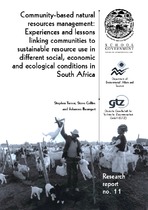
Community-based natural resources management: Experiences and lessons linking communities to sustainable resource use in different social, economic and ecological conditions in South Africa
(Institute for Poverty, Land and Agrarian Studies, University of the Western Cape, 2002)The project, which started in 1996 in partnership with the South African Department of Land Affairs (DLA), supports communities that have a stake in nature conservation areas through ownership, or a claim to ownership, ... -
The interaction between the land redistribution programme and the land market in South Africa: A perspective on the willing-buyer/willing-seller approach
(Institute for Poverty Land and Agrarian Studies (PLAAS), 2002)The debate rages on, in South Africa and elsewhere, about the desirability and efficacy of the willing-buyer/willing-seller approach to land redistribution. In South Africa, the willing-buyer/willing-seller approach is ... -
Decentralisation and natural resource management in rural South Africa: problems and prospects
(Institute for Poverty Land and Agrarian Studies (PLAAS), 2002)In this paper, the issue of decentralisation and natural resource management will be interrogated primarily through a focus on local government reform and land administration. This focus illuminates problems that are on ... -
The tragic African commons: A century of expropriation, suppression and subversion
(Institute for Poverty Land and Agrarian Studies (PLAAS), 2002)This paper examines the nature of the African commons as a property system; analyses the extent of damage which was inflicted upon it during one hundred years of exploitation, suppression and subversion; explains why, in ... -
Reforming communal land tenure in South Africa – Why land titling is not the answer
(Institute for Poverty, Land and Agrarian Studies, University of the Western Cape, 2002)The long-awaited draft Communal Land Rights Bill sets out government’s proposals to resolve urgent land tenure problems in the former ‘homeland’ areas, where most rural South Africans still live, and where land is ... -
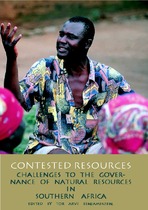
Contested resources: Challenges to the governance of natural resources in Southern Africa
(Institute for Poverty Land and Agrarian Studies (PLAAS), 2002)Papers from the International Symposium on ‘Contested Resources: Challenges to Governance of Natural Resources in Southern Africa. Emerging perspectives from Norwegian-Southern African collaborative research’ held at The ... -
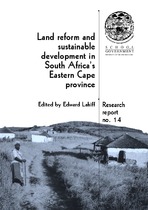
Land reform and sustainable livelihoods in South Africa's Eastern Cape province
(Institute for Poverty, Land and Agrarian Studies, University of the Western Cape, 2002)The Eastern Cape is one of the nine provinces of South Africa, located in the south-east of the country along the Indian Ocean seaboard. The area was a site of prolonged struggle between native peoples, principally Xh ... -
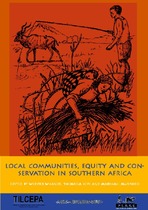
Local communities, equity and conservation in southern Africa: A synthesis of lessons learnt and recommendations from a southern African technical workshop
(Institute for Poverty Land and Agrarian Studies (PLAAS), 2003)This publication reports on a technical workshop entitled ëCommunities and Conservation in Southern Africa: Key Issues and Challenges towards a more Equitable and Sustainable Futureí, which was held on 26ñ28 February 2003 ... -
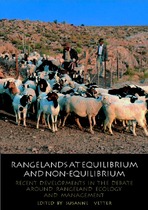
Rangelands at equilibrium and non-equilibrium recent developments in the debate around rangeland ecology and management
(Institute for Poverty, Land and Agrarian Studies, University of the Western Cape, 2003)The debate on equilibrium vs non-equilibrium dynamics in pastoral systems emerged in the early 1980s, when economists, ecologists and social scientists began to challenge the widespread claims of overgrazing and degradation ... -
Submission to the portfolio committee for land and agriculture: The communal land rights bill
(Institute for Poverty Land and Agrarian Studies (PLAAS), 2003)The National Land Committee (NLC) and the Programme for Land and Agrarian Studies (PLAAS) of the University of the Western Cape have been funded by DfID UK (Department for International Development) to undertake a process ... -
TRANCRAA and communal land rights: Lessons from Namaqualand
(Institute for Poverty, Land and Agrarian Studies, University of the Western Cape, 2003)The Transformation of Certain Rural Areas Act, Act 94 of 1998 (TRANCRAA) is the first comprehensive legislation to reform communal land tenure in South Africa. It aims to transfer land in 23 former coloured rural areas ... -
Land use and rural livelihoods: Have they been enhanced through land reform?
(Institute for Poverty, Land and Agrarian Studies, University of the Western Cape, 2003)It is often assumed that transferring land to rural households will provide people with valuable assets that can be productively used to enhance their livelihoods. Unfortunately, few rural people or land reform beneficiaries ... -
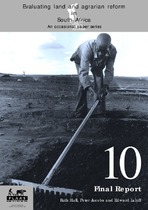
Evaluating land and agrarian reform in South Africa : Final Report
(Institute for Poverty Land and Agrarian Studies (PLAAS), 2003)Land dispossession was a key feature of racism under colonial rule and apartheid in South Africa. More than 3.5 million people were forcibly removed in the period 1960 to 1983 alone, through homeland consolidation, removals ...