Browsing Faculty of Law by Subject "Police training"
Now showing items 1-2 of 2
-
Combrinck, Helene; Wakefield, Lorenzo (Institute for Security Studies, 2010)[more][less]
Abstract: As anticipated by the drafters of the Domestic Violence Act (DVA), the South African Police Service holds the key to the successful implementation of the Act. Over the past ten years, researchers and independent bodies tasked with monitoring the implementation of this legislation have consistently called for more training for police officials on how to deal with domestic violence. However, the reality is that police officials already receive such training. The question that therefore arises is why these training programmes appear to be ineffective in ensuring compliance with the DVA. A recently completed research and advocacy project found that although the majority of SAPS members interviewed had a basic understanding of the DVA and its key concepts, their ability to apply its provisions in practical problemsolving scenarios was often limited, leading to the recommendation that training methodologies should be more practice-oriented if they are to improve DVA compliance. URI: http://hdl.handle.net/10566/576 Files in this item: 1
CombrinckDomesticViolence2010.pdf (1.122Mb) -
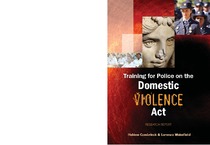
Combrinck, Helene; Wakefield, Lorenzo (Community Law Centre, University of the Western Cape, 2009)[more][less]
Abstract: The inadequate or inappropriate police responses to domestic violence often result from a lack of knowledge of the Domestic Violence Act (DVA) and the National Instruction or from a misinterpretation of the DVA’s provisions. In the interviews undertaken, the central question asked was: ‘Do current training programmes provide SAPS members with the knowledge and skills required to apply the DVA and National Instruction in practice?’ It appeared from the interviews that the majority of the research participants had a basic awareness of the DVA and the National Instruction. However, when it came to the practical application of knowledge in a ‘problem-solving’ scenario, it was notable that the majority of interviewees experienced difficulties when multi-faceted variables were included. It was recommended that more members need training on the DVA, and more frequent and/or more in-depth courses should be offered. Furthermore it was recommended that special attention be devoted to training on domestic violence during the basic six months’ training for new students. URI: http://hdl.handle.net/10566/209 Files in this item: 1
CombrinckDVA2009.pdf (1.059Mb)
Now showing items 1-2 of 2