Browsing by Subject "University of the Western Cape"
Now showing items 1-20 of 78
-
The academic transitional experiences of masters’ students at the University of the Western Cape
(AOSIS OpenJournals, 2012)Transition has been a major focus of educational institutions. However, most of the research into student transition focuses on the challenges related the transition from high school to university. Not much emphasis has ... -
Adapting an undergraduate dental objectively structured clinical examination (OSCE) during COVID‑19
(Health and Medical Publishing Group, 2021)In the 5-year dentistry curriculum at the University of the Western Cape, South Africa (SA), prosthetic dentistry is presented as modules, starting in the 2nd year and culminating in the final module in the 5th year. Students ... -
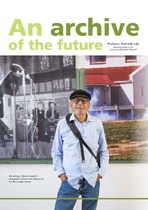
An archive of the future
(José Frantz, 2020)The University of the Western Cape (UWC) recently entered into a partnership with photographer Rashid Lombard to house his substantial archival collection, which promises to offer expanded perspectives on the everyday ... -
Audit report: University of the Western Cape Research Output 2014
(2015)This audited list documents the accredited research output published by researchers at the University of the Western Cape for the year 2014. The list is provided by the Research Office at the University. -
BECOMING-MINORITARIAN Constructions of coloured identities in creative writing projects at the University of the Western Cape, South Africa
(Taylor & Francis, 2020)The institutional history of the University of the Western Cape (UWC) in some ways mirrors the paradoxes, ambiguities, absurdities, contradictions and possibilities – in short, the complexities – of the concept “coloured”. ... -
The centre for multilingualism and diversities research at the University of the Western Cape, South Africa
(University of the Western Cape, 2014)There is an urgency in theorising how diversity is negotiated, communicated, and disputed as a matter of everyday ordinariness that is compounded by the clear linkages between diversity, transformation, voice, agency, ... -
The constitutional conversation between the federal structure and a bill of rights
(Community Law Centre, University of the Western Cape, 2015-01)It is often assumed that a constitution speaks with one voice and that all parts are in harmony with each other. Although different provisions can be given higher status than others (as reflected in the more arduous amendment ... -
Continuing professional education at the University of the Western Cape - survey results
(University of the Western Cape, 1997)UWC has since 1998 a new Mission Statement which commits the university to Lifelong Learning. Since 1996 there has been a process to give content to this commitment. The process included surveys of distance education and ... -
Continuous workplace-based assessment as an indication of clinical competence in paediatric dentistry
(International Network for Higher Education in Africa, 2021)An authentic workplace setting provides the ideal opportunity for assessment of students’ clinical competence at the ‘does’ level of performance. Final-year dental students in the Department of Paediatric Dentistry at ... -
Das Fach Deutsch an der University of the Western Cape
(Association of German Studies (SAGV), 2010)The current challenges facing the teaching of German as a foreign language at the University of the Western Cape are outlined. The article includes a brief historical overview and proposes research perspectives for the future. -
Decentering and recentering the writing centre using online feedback: Towards a collaborative model of integrating academic literacies development
(Stellenbosch University, 2019)Since its inception in 1994, the University of the Western Cape’s Writing Centre has been on the margins, viewed as an add-on to central learning and teaching activities at the university (Archer and Richards 2011, ... -
Development of molecular tools for honeybee virus research: the South African contribution
(Academic Journals, 2003)Increasing knowledge of the association of honeybee viruses with other honeybee parasites, primarily the ectoparasitic mite Varroa destructor, and their implication in the mass mortality of honeybee colonies has resulted ... -
‘Digital Natives’ Require Basic Digital Literacy Skills
(University of the Western Cape, 2016)This paper discusses a Digital Academic Literacy (DAL) Programme at the University of the Western Cape (UWC). It highlights the programme's response to and alignment with emerging South African Higher Education (HE) national ... -
Discussion document: understanding the dynamics of part-time studies at UWC
(University of the Western Cape, 2003)This study into understanding the dynamics of part-time studies at UWC is part of on-going institutional research that is required to improve the conditions of and services to part-time students at UWC. Approximately 23% ... -
Diversity and contested social identities in multilingual and multicultural contexts of the University of the Western Cape, South Africa
(Taylor & Francis, 2015)We draw on Rampton's Crossing: Language and Ethnicity Among Adolescents (2014. 2nd ed. New York: Routledge) notion of 'crossing' to explore contestations in ethnolinguistic, cultural and racial affiliations at the ... -
Dynamics of building a better society: Reflections on ten years of development cooperation and capacity building
(SUN Media, 2014)The modern world is an environment of rapid change. Per Dalin points out that we are experiencing an unprecedented ten revolutions occurring simultaneously. There are revolutions prompted by globalisation and the population ... -
Eighth Annual Julius Nyerere Memorial Lecture Presented by Kumi Naidoo in 2011
(University of the Western Cape, 2011)Eighth Annual Julius Nyerere Memorial Lecture Presented by Kumi Naidoo in 2011 -
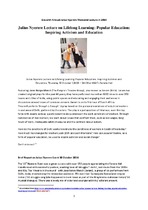
Eleventh annual Julius Nyerere memorial lecture in 2014
(University of the Western Cape, 2015)The event included a live performance by Jana Natya Manch (The People’s Theatre Group), also known as Janam (Birth). Janam has created original plays for the past 40 years; they have performed more than 8000 times in over ... -
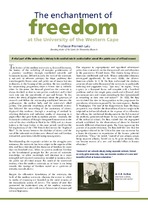
The enchantment of freedom at University of the Western Cape
(José Frantz, 2020)The history of the modern university is ,first and foremost ,the history of the unfolding of complex problematics of a planetary condition through established scientific and humanistic inquiry. Defined as such, the work ... -
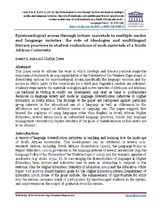
Epistemological access through lecture materials in multiple modes and language varieties: the role of ideologies and multilingual literacy practices in student evaluations of such materials at a South African University
(Springer, 2016)This paper seeks to address the ways in which ideology and literacy practices shape the responses of students to an ongoing initiative at the University of the Western Cape aimed at diversifying options for epistemological ...