Browsing Faculty of Law by Subject "Hospitality"
Now showing items 1-2 of 2
-
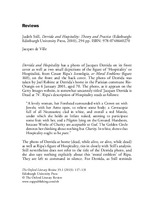
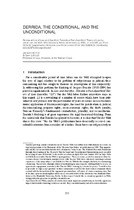
De Ville, Jacques (Juta Law, 2007)[more][less]
Abstract: In his recent book, Law and Sacrifice: Towards a Post-Apartheid Theory of Law, Johan van der Walt gives a clear exposition of the possible impact of inter alia Jacques Derrida's thinking on law. In this article, the book is critically analyzed and it is shown that Derrida's texts provide scope for a different interpretation. With reference to a number of themes it is shown that Derrida's thinking is more far reaching than in Van der Walt's model. The unconditional for example plays a vital role in Derrida's thinking while it is almost absent in Van der Walt's model. Van der Walt stresses the need for plurality and the impossibility of reconciliation between different views of the law in a particular case. Such an approach can have conservative political consequences. A different interpretation of Derrida, where the unconditional is more prominent, holds more promise for a post-apartheid theory of law. URI: http://hdl.handle.net/10566/382 Files in this item: 1
DevilleLawSacrifice2007.pdf (409.2Kb) -
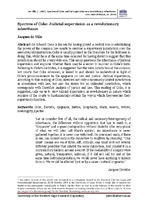
De Ville, Jacques (Springer Verlag, 2007)[more][less]
Abstract: Sir Edward Coke is known for having played a central role in establishing the power of the common law courts to exercise a supervisory jurisdiction over the executive/administration. Coke is usually praised in the literature for his boldness in doing this, whilst he is at the same time censured for having dared to suggest that this jurisdiction should be a very wide one. This essay questions the inheritance of judicial supervision and enquires whether there may be a secret to uncover in Coke’s texts. Referring to Coke’s Institutes, it is suggested that the wide jurisdiction of the common law courts that Coke advanced, is linked to and should be understood in light of Coke’s pronouncements in the epigrams on law and justice. Judicial supervision, according to this reading of Coke, involves not only a necessarily limited jurisdiction in accordance with law, but also the desire for an unlimited jurisdiction, which corresponds with Derrida’s analysis of justice and law. This reading of Coke, it is suggested, calls on us to view judicial supervision as revolutionary in nature which requires of the courts to fundamentally rethink the way in which they exercise their supervisory function. URI: http://hdl.handle.net/10566/371 Files in this item: 1
DeVilleJudicialSupervision2007.pdf (273.1Kb)
Now showing items 1-2 of 2